
Central African Republic
CAR has been engulfed in a violent conflict since 2013, forcing millions of people to flee their homes.

Only about 75 percent of Central African Republic citizens have access to clean water. Photo: ICRC
Overview
The humanitarian crisis in CAR is characterised by violent conflict which started in 2013 and flared up in 2017 and 2020, forcing millions of people to flee their homes. In 2024, around half a million people remain internally displaced. The crisis is compounded by conflict - an increase in armed violence, conflicts related to transhumance, violations of human rights and international humanitarian law – and environmental and economic deterioration - worsening floods, a socio-economic recession and weak basic services. As a result, 2,8 million people are estimated to need humanitarian assistance in 2024.
More than 100 organisations currently provide humanitarian assistance in CAR, helping to alleviate the immediate effects of food insecurity and malnutrition, provide shelter, water, sanitation, health and education services, and protect a population in distress. The majority of implementing organisations are national and international NGOs. The response reached 2 million people in 2023.
The humanitarian community in CAR is committed to the guiding principles of proximity, protection, and participation, and has made good progress on improving accountability on a collective level, putting in place coordination structures and collective feedback mechanisms, measuring aid recipients’ perceptions, consulting communities for the elaboration of the humanitarian needs and response plan (HNRP) and demanding minimum accountability standards for fund allocations.
Our work
We have been operational in CAR since 2019 with the support of UNICEF and GFFO. Since May 2024, we have been working on a project to support Clusters to enhance collective accountability.
Between August 2023 and April 2024, we worked with UNICEF in CAR to ensure that their community engagement strategies are informed by community perceptions. We conducted a mixed-method study to explore communities’ views on the aid and services they receive, and the way they engage with aid providers. The findings were discussed in a series of workshops, and translated into concrete action plans for community engagement.
Between 2020 and 2023, we conducted qualitative and quantitative studies as part of the Cash Barometer project. We held a series of qualitative interviews with CVA recipients and market traders, asking for their perspectives on the COVID-19 pandemic, on protection risks they face at different stages of the process when receiving assistance, and on their reasons for preferring one aid modality over the other. A quantitative survey allowed for further analysis of people’s perceptions of aid.
Between 2019 and 2021, we supported the Humanitarian Country Team to track eight perception indicators that were included into the Humanitarian Response Plan, as a tool to measure its implementation from the aid recipients’ perspective.
We also supported the CAR Rapid Response Mechanism and two clusters to improve their accountability practices and developed collective processes to collect and use feedback from aid recipients.

Our projects in CAR


The Cash Barometer launched in CAR in 2020 in the context of the COVID-19 pandemic, where we sought to capture the voices of market traders and CVA recipients in the context of the developing crisis. Since then, CVA significantly scaled up in CAR, making it even more critical than ever to ensure the voices of CVA recipients are heard.

Global claims of improved accountability in humanitarian action are not often supported by evidence. That’s why we work with humanitarian actors in CAR who are aiming to improve accountability to affected populations, by tracking and sharing the views of people receiving aid.

Covid-19 has sparked an economic crisis that will disproportionately affect the most vulnerable members of society, particularly in humanitarian contexts. The Cash Barometer project explores its economic impact, helping humanitarians to better understand its various effects, as well as to what extent recipients’ perspectives inform cash and voucher assistance (CVA) responses, on two levels: global and in-country.

In the Central African Republic (CAR), Ground Truth Solutions has worked with UNICEF to track the perceptions of affected communities and other key actors on the humanitarian response to Covid-19.
Latest publications from CAR


Espèces, coupons… ? Ou simplement une meilleure mise en oeuvre ? Ce que veulent les personnes recevant l’aide à Kaga-Bandoro

Cash or vouchers? Or just good implementation? What aid recipients in Kaga-Bandoro want

With the stakes so high, is Cash and Voucher Assistance the lifeline it’s meant to be?

Face à des enjeux aussi cruciaux, les transferts monétaires font-ils le poids?

Expériences des bénéficiaires d’assistance monétaire en République Centrafricaine

Experiences of cash and voucher assistance in the Central African Republic

Renforcement de la redevabilité en Centrafrique Berbérati December 2021

Renforcement de la redevabilité en Centrafrique Kaga Bandoro December 2021

Renforcement de la redevabilité en Centrafrique Alindao December 2021

Renforcement de la redevabilité en Centrafrique Bangui December 2021

Renforcement de la redevabilité en Centrafrique Bambari December 2021

Que pensent les populations affectées de la réponse humanitaire en République Centrafricaine?
How do aid recipients feel about the humanitarian response in the Central African Republic?
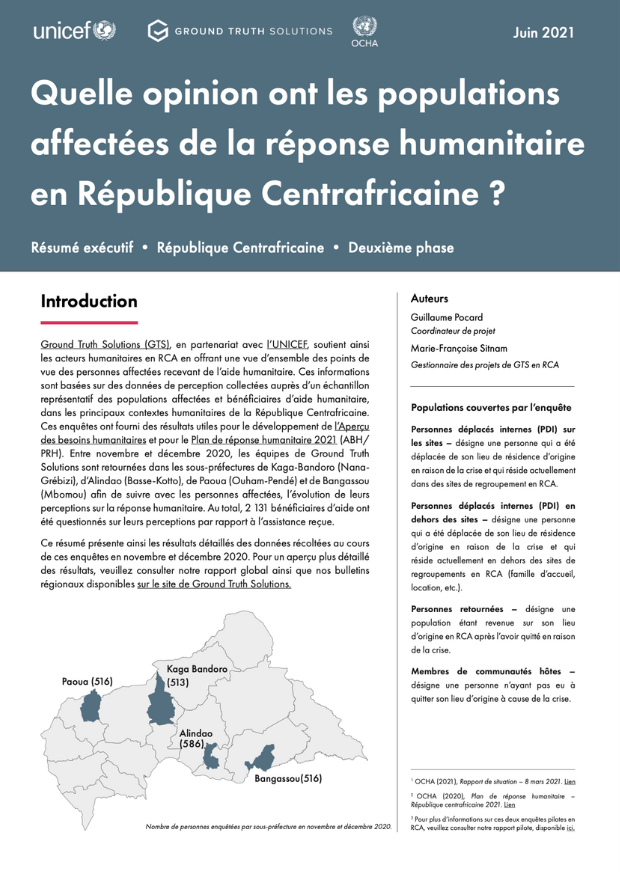
Quelle opinion ont les populationsaffectées de la réponse humanitaireen République Centrafricaine ?Résumé exécutif
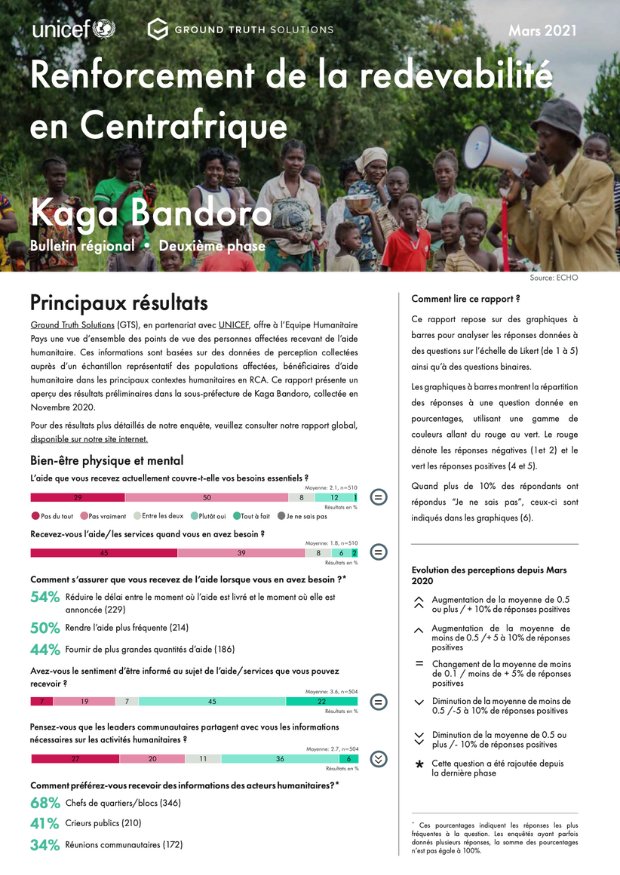
Renforcement de la redevabilité en Centrafrique Kaga Bandoro March 2021

Renforcement de la redevabilité en Centrafrique Paoua March 2021

Renforcement de la redevabilité en Centrafrique Bangassou March 2021

Renforcement de la redevabilité en Centrafrique Alindao March 2021

Enquête auprès des ménages centrafricains sur leurs perceptions de la COVID-19

Témoignages clés de commerçants et bénéficiaires d’assistance monétaire

Perceptions of cash and voucher recipients and market traders on received aid and COVID-19

Analysis: Cash Barometer Central African Republic - August 2020
Renforcement de la redevabilité envers les populations affectées June 2020
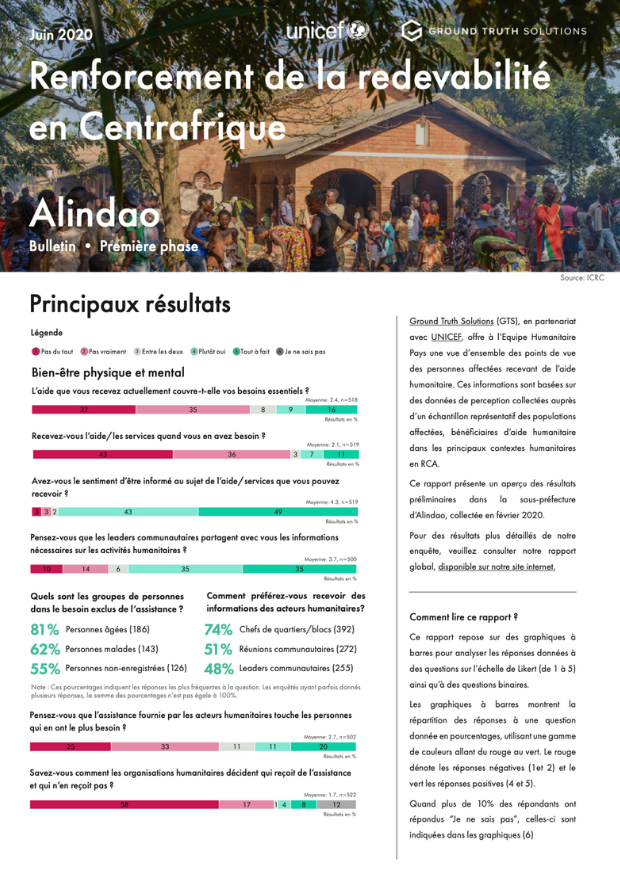
Renforcement de la redevabilité en Centrafrique Alindao June 2020

Renforcement de la redevabilité en Centrafrique Batangafo June 2020

Renforcement de la redevabilité en Centrafrique Bambari June 2020
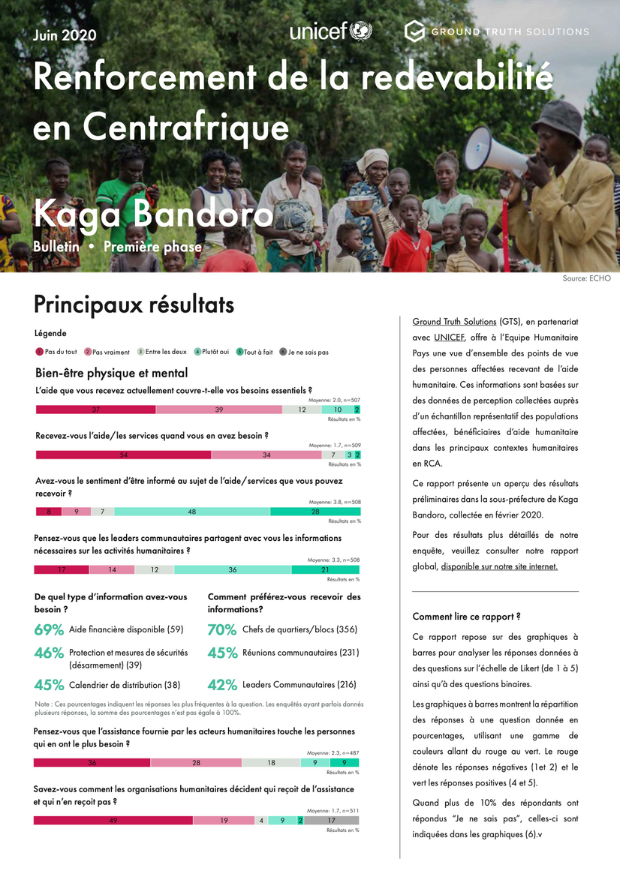
Renforcement de la redevabilité en Centrafrique Kaga Bandoro June 2020

Renforcement de la redevabilité en Centrafrique Bangassou December 2019