
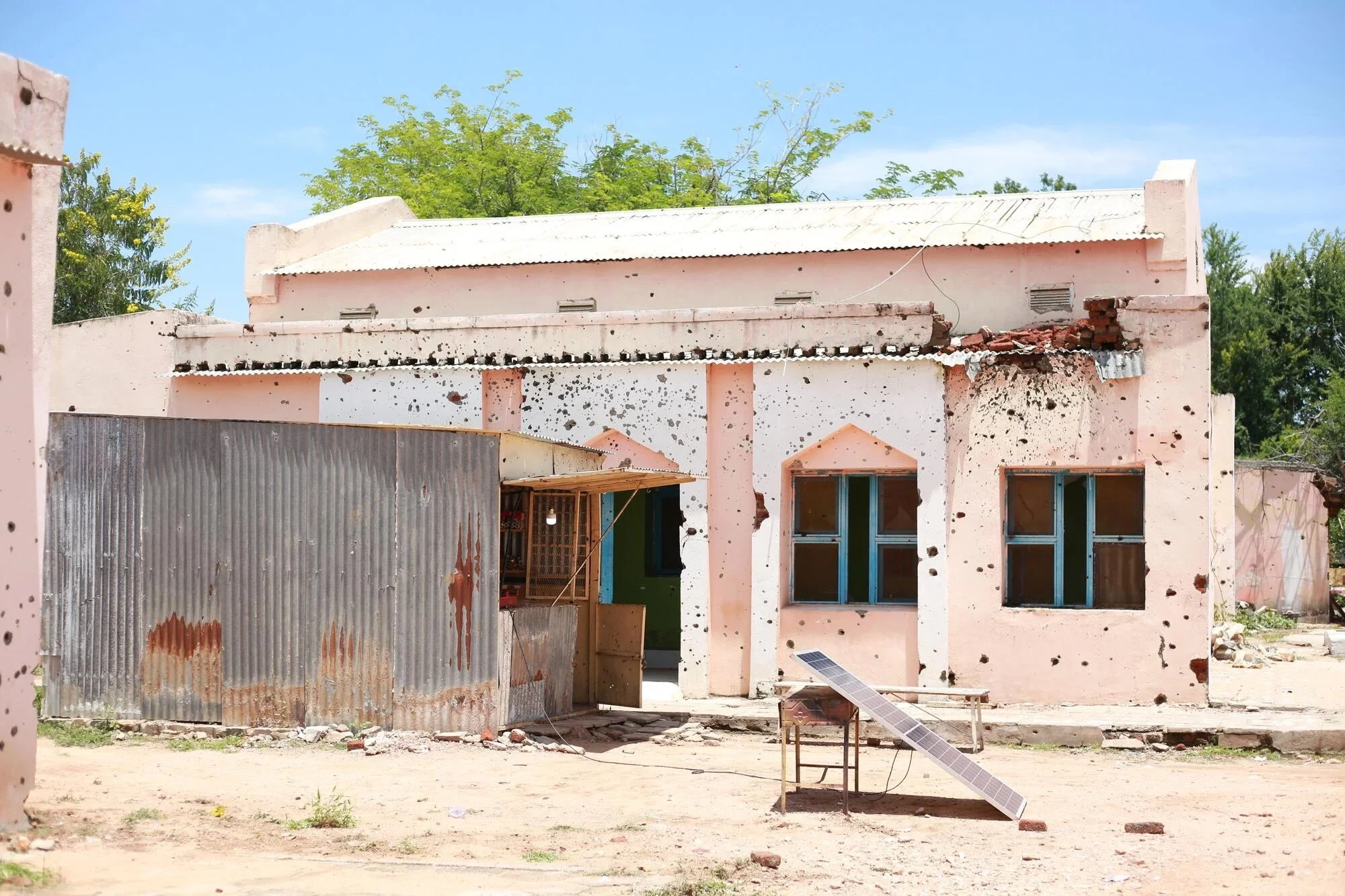
Destruction at the Nyala Teaching hospital in Sudan, 5 September 2024. Abdalla Berima/MSF – MSF. A Year in Pictures 2024.
In late 2024, Ground Truth Solutions and DataQ spoke with people in Gedaref and South Darfur to understand their priorities, concerns and perceptions of the humanitarian response in Sudan. These two states represent different administrative and security contexts: Gedaref is under the control of the Sudanese Armed Forces (SAF), while South Darfur is under the authority of the Rapid Support Forces (RSF). Even before the recent aid cuts, humanitarian actors were struggling to meet growing needs across Sudan.
With 25 million people facing acute food insecurity and record numbers of people forced out of their homes the trickle of aid still reaching Sudan is dwarfed by need. The people of Gedaref and South Darfur continue to endure harsh living conditions, with limited access to basic necessities. Many families are forced to rely on borrowing, selling personal belongings, or skipping meals to survive. Across both states, many respondents identified running out of life-sustaining supplies as their biggest worry.
“We feel humiliated, we have nothing to eat or drink, and there is no one to help us… It is normal for us to sleep for a day or two without eating.”
Everyone we spoke to had a clear message for the international community – bring an end to the war so people can live without fear for their lives.
“Save us, stand with us, stop the war in Sudan. We are suffering from hunger, thirst and disease.”
“Politically, efforts should focus on ending the war because the Sudanese people have suffered enough from the horrors of this conflict. It’s time to bring peace and relief to the citizens.”
But they also appealed for an urgent increase in lifesaving assistance. In South Darfur only 45% of people we spoke to had received humanitarian assistance in the last 6 months, and in Gedaref just 33%. People told us the single greatest barrier to accessing humanitarian aid and services is that there is simply not enough aid available. People urged aid providers to scale-up aid provision to meet the increasing demand.
“This aid is not reaching us at all, and we don’t know the reason or who to complain to.”
All across Sudan, community-based initiatives have continued to support people in crisis, even as humanitarian aid has fallen short. This support often comes in the form of food aid, including through communal kitchens. However, these initiatives have been decimated by recent USAID cuts, with recent reports suggesting as much as 80% of communal kitchens have been forced to close across the country.
Several people we spoke to expressed a profound sense of abandonment:
“The international community is standing by, doing nothing. If they truly want to stop the war, they have the power do so, but I don’t see them taking action.”
Now, following massive cuts and with a further deterioration in the crisis, aid providers face impossible decisions. We share insights from people we spoke to which should help decision-makers approach these impossible choices.
People shared four clear messages:
Listen carefully to what we need, and prioritise accordingly
People appealed to aid providers to ensure the aid that does arrive meets their most pressing needs. Food is by far the top priority for the vast majority of people we spoke to – yet this is not reflected in the current aid efforts. In South Darfur, non-food items are the most common form of assistance by a considerable distance and only 30% of aid recipients received food items in the past 6 months. For the majority of aid-recipients that we spoke to across both states, the aid that they receive does not meet their most important needs.
Many displaced people have lost everything—not just food and shelter, but jobs, education, healthcare, and entire support systems. Now, with some areas marked as “safe to return,” they’re being asked to return to nothing. If aid providers don’t listen—really listen—they risk designing responses that overlook the full scale of loss, and miss what people actually need to rebuild their lives.
People point to a lack of consultation as the cause of this mismatch. Just 7% of those surveyed in Gedaref and 31% in South Darfur believe that aid providers consult members of their community before providing assistance. “I wish they would visit the homes to understand the reality of the situation and the needs of the people” urged a displaced woman in Madeinet al Gedaref.
In both Gedaref and South Darfur, many people feel excluded from decision-making processes regarding aid distribution. Respondents expressed a strong desire to participate so that they could help prevent corruption, improve fairness, and ensure that the most vulnerable individuals receive support.
“I want to take part in the distribution to give aid to those who are unfairly treated, identify the people who truly deserve the assistance, and ensure it reaches them.”
2. Focus on reaching the most vulnerable people
There are widespread perceptions that aid does not reach the most vulnerable, with less than half of the people we spoke to saying that aid goes to those who need it most. In South Darfur, many people feel that the wrong individuals are prioritized while vulnerable groups—such as the elderly, disabled, and single mothers—are overlooked. Many respondents highlighted a common blind spot: aid providers disproportionately focus on people living in collective shelters while neglecting those living in host communities and the host communities themselves.
“I don’t know the exact reason, but sometimes they give aid to people who don’t need it, like someone healthy and capable of working, while they neglect someone who is ill or disabled and unable to work.”
Several people in South Darfur expressed frustration over what appears to be arbitrary or unjustified selection criteria. Just one-quarter of those surveyed in Gedaref and 9% in South Darfur understand how aid providers decide who receives assistance, and trust in aid actors to make those decisions fairly is low.
3. Make aid distribution fairer and more transparent
As well as not reaching those who need it most, a recurring theme in both states is the belief that aid is not fairly distributed. In Gedaref and South Darfur just 16% and 26% of people surveyed believe that aid is provided fairly in their communities. Many people blame favouritism and nepotism in the selection of aid recipients, with local leaders and intermediaries accused of prioritizing their acquaintances. There is a widespread concern that people in positions of power assume gatekeeping roles restricting access to aid those within their inner circles. One displaced woman in Nyala Janoub, South Darfur, described her experience: “Aid isn’t distributed at all; instead, it is excessively hoarded in the homes of local leaders, and the eligible individuals and the poor receive nothing.”
Civilians across Sudan are exposed to grave protection risks. Caught between warring parties who have shown an utter disregard for civilian lives, they face a relentless threat of human rights abuses, shelling, and bombardment. But when asked what aid providers can do to make them feel safer in the implementation of their activities, several people highlighted that, unfair aid distribution combined with insufficient aid, can be incendiary. A woman living in Ar Rahad simply called for “clarity in decisions and justice among people.”
Despite the extreme conditions people are enduring, many of the people we spoke to expressed a desire to be better informed about, and more closely involved in, aid distribution decisions. Making and communicating these decisions more transparently, and involving communities in identifying the most vulnerable, would go a long way towards increasing trust in and satisfaction with aid.
4. Provide direct and reliable information about the aid that’s available
Access to accurate and timely information is crucial in times of crisis, yet many in Gedaref and South Darfur struggle to obtain reliable details about available aid and services. In Gedaref, 29% of respondents cited a lack of clear information as a major impediment to receiving aid, while misinformation was another frequently mentioned obstacle.
“Some of the displaced people do not know the date of the distribution, and when they come to the distribution point, they find that the aid has run out.”
In South Darfur, where telecommunications infrastructure has been heavily damaged, people face additional challenges. Large parts of the state have experienced prolonged blackouts, leaving many disconnected from humanitarian providers. When asked how they currently receive information about aid, 82% of respondents said they rely on word-of-mouth rather than direct communication from aid providers. Only 12% receive information through household visits, 12% at distribution points, and 11% via community meetings.
People expressed a strong preference for more direct communication from aid providers. In Gedaref, 59% of respondents wanted to receive updates via phone calls, while in South Darfur, 49% preferred direct visits from aid workers.
“Authorities should announce the time and place of aid distribution in advance and communicate with people beforehand to ensure they understand that everyone is receiving the same help. This would build trust and transparency.”
Conclusion
As the gap between needs and resources grows, humanitarian actors are forced to make tough decisions about how to prioritise dwindling aid flows. People in Gedaref and South Darfur have shared clear messages: aid must align with their most pressing priorities, must keep a laser focus on reaching the most vulnerable, must avoid being captured and diverted and must be clearly communicated. Aid cuts in Sudan will have a devastating human cost, but without centring the voices and needs of conflict-affected communities, the damage will be even more severe.
By Finn Blair at Ground Truth Solutions, and Arwa Babiker and Fidaa Mergani at DataQ